
InduoIQ™
Here's how the IQ Score works.
How scoring works
The Induo IQ Score, on a scale of 100, rates a company's interview process — how it treats the people it interviews. It does not measure whether you got the job. Outcomes never affect the score.
A company's score is derived from three pillars. Each one measures a different dimension of the company's interview process.
01
How they showed up
The most direct signal of how a company treats people. Punctuality, preparation, demeanor. Hard to fake.
What we measure
02
Communication
How informed and respected you felt across the process. Clear timelines kept. A recruiter who was helpful, not invisible. Silence and ghosting cost more than companies realize.
What we measure
03
Technique
The quality of the questions themselves. Clear, relevant, thoughtful follow-ups. Important, but easier to polish without changing how a company treats people.
What we measure
See a worked example: how the IQ Score is calculated
Each person's Induo IQ Score, on a scale of 100, is built in two steps.
Step 1 — Score each pillar
Each pillar is the average of the specific ratings candidates give in that category:
- How they showed up averages punctuality, preparation, time left for your questions, and demeanor. For virtual rounds, it also includes whether the interviewer kept their camera on.
- Communication averages how clearly and promptly you were kept informed across the process, and how responsive your main point of contact was.
- Technique averages the clarity of the questions asked and the quality of the interviewer's follow-ups.
Each rating maps to a value on a scale of 100, and the ratings in a pillar are averaged to give that pillar's score. If something didn't apply, you can mark it N/A.
Step 2 — Apply the weights
| Pillar | Score |
|---|---|
| How they showed up | 83 |
| Communication | 74 |
| Interview Technique | 61 |
| Induo IQ Score | 75* |
* = IQ Score weighting applied
Every score is out of 100 and is an average of the answers given. Each person's pillar scores are weighted and combined into their own Induo IQ Score. A company's Induo IQ Score is the average of those individual scores. All scores are rounded to whole numbers.
Camera-off signal (virtual interviews)
When any interview round was virtual, we ask whether the interviewer kept their camera on. This is averaged into the ③ How they showed up pillar score. The rationale is grounded in research: video interviews are often perceived as less warm and less fair than in-person, an effect driven by reduced eye contact and lower “social presence” (Basch, Melchers, et al., 2021; Blunden & Brodsky, 2024). An interviewer who keeps their camera off removes exactly those cues — so we treat camera-off as a negative signal within how they showed up.
Grounded in research
Induo IQ is anchored in data. The research supports the three pillars, the weighting applied to them, and the scoring methodology that follows. Here's how.
Decades of research converge on the same finding (Bauer et al., 2001; Chapman et al., 2005). How a company treats candidates during interviews matters more than anything else. It shapes whether candidates see the process as fair, whether they accept an offer, and whether they recommend the company to others.
Gilliland (1993) adds another angle. He identifies two-way communication as a core procedural rule of fair hiring. When candidates are given no real time to ask their own questions, that rule is broken. The process becomes one-sided.
That's exactly why Induo IQ built three scoring pillars, each weighted to reflect its research-backed link to a fair, respectful interview process. How candidates are treated, how clearly and promptly they're kept informed, and the quality of the questions they're asked all factor into the score.
How to read a score
Company pages appear only once a company has a minimum number of distinct verified submitters.
Early signal
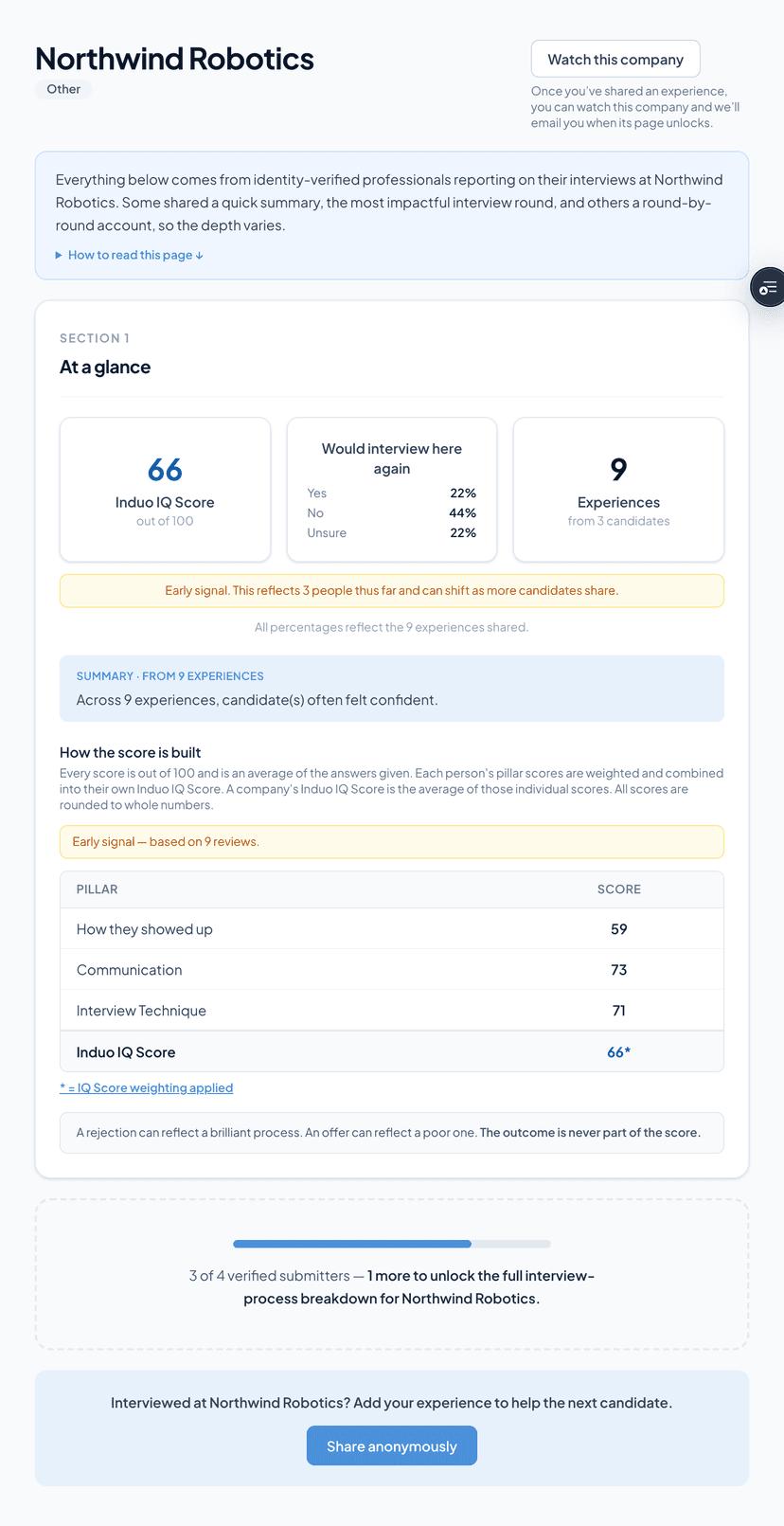
Example only — not a real company.
Full picture

Example only — not a real company. Unlocked as more experiences come in.
A score built from a handful of experiences is a narrower picture than one built from fifty. Every company page shows how many experiences its score is based on, and a score can shift as more candidates share.
Every submission is one person's account of their own interview experience. We verify that the submitter is a real professional; we don't verify the experiences themselves. Candidates choose from pre-set options, and only what they select is published.
What we don't score
The outcome. The quality of a process and the result of it are two completely different things.
An offer can still reflect a poor interview experience. And yet, a rejection can still reflect a brilliant one. That's exactly why we don't score the outcome.
Whether you received an offer or not is captured for context but never included in the score. Induo IQ focuses on the interview experience itself: understanding it, sharing it, and turning it into shared intelligence.